Yes, for Aboriginal land off public roads: it is private land, and you need a permit from the land council or Aboriginal body to enter it, travel its roads such as the Great Central Road, or stay overnight. Passing through a community on a public road needs no permit to reach its public areas such as the store, and where camping is allowed on Aboriginal land it is at designated sites that the permit or park names.
The short answer by state
There is no single Australian permit. Each land council, state agency or Aboriginal corporation issues its own, and the same trip can need two or three. Apply before you leave, because the land council or agency consults Traditional Owners before it decides.
| State or territory | Permit and who issues it | Camping | Source |
|---|---|---|---|
| Northern Territory, Central Australia | Central Land Council transit permits for Tjukaruru Road, Gary Junction Road, Sandy Blight Road and Glen Helen to Papunya Road. Mereenie Tour Pass for the Mereenie Loop. Entry permit for other non-public roads and the Simpson Desert tracks. | Tjukaruru Road: only at the Kaltukatjara (Docker River) campground. Mereenie Loop: no camping. | Central Land Council |
| Northern Territory, Top End | Northern Land Council permit to enter Aboriginal land, use its private roads, or visit a community. Allow up to 10 days, and more for recreation permits. | Only if camping is written into the permit, at recreation sites the Traditional Owners have identified. | Northern Land Council |
| Western Australia | Transit permit through the Aboriginal Lands Trust reserves from the Department of Planning, Lands and Heritage, plus a 3-day Ngaanyatjarra Council permit for the Great Central Road and other roads on its list. | The Council's transit permit gives three days and two nights. Great Central Road visitors cannot enter communities. | WA Government, Ngaanyatjarra Council |
| Kimberley, Western Australia | Uunguu Visitor Pass for Mitchell River National Park, bought online before you arrive. | DBCA camping fees apply at the park's campgrounds. | Explore Parks WA |
| South Australia | APY Lands: no transit permits for tourists. Maralinga Tjarutja Lands and Mamungari Conservation Park: permit from Maralinga Tjarutja, allow 4 to 6 weeks. | Mamungari Conservation Park: entry is free and camping fees apply. | APY, NPWS South Australia |
| Queensland, Cape York | No single permit. Contact the Land Trust or local council for permission to camp on Aboriginal land. | Pre-book national park campsites in advance. | Cape York Tourism Guide |
| Commonwealth parks | Park pass for Kakadu and for Uluru-Kata Tjuta. These are entry fees, not Aboriginal land permits. | No camping inside Uluru-Kata Tjuta. Kakadu: designated campgrounds, with a permit to camp elsewhere. | Parks Australia |
- Plan weeks ahead
- Permits are not shared across borders
- Checked 2026-10-21
Why a permit is needed
The Central Land Council says Aboriginal people own more than half the land in its region as inalienable freehold under the Aboriginal Land Rights (Northern Territory) Act 1976, and that it is private land. The Northern Land Council says the same: Aboriginal land is not Crown land or public land, and Commonwealth and Northern Territory law require a written permit to enter it.
Travellers who stay on public roads in the CLC region do not need one. The CLC says anyone passing through a community on a public road can visit its public areas, such as the store, art centre or local government office, without a permit. A transit permit is needed if the community is reached by a non-public road. In Western Australia, the Aboriginal Lands Trust estate covers over 8 per cent of the state, and entry onto its reserved lands needs an Entry Permit.
- Aboriginal land is private land
- Public roads: no land permit
- Written permit, not verbal
Which routes need a permit
In Central Australia the CLC lists Tjukaruru Road between Uluru-Kata Tjuta and the WA border, Gary Junction Road, the Sandy Blight Road and the Glen Helen to Papunya Road. The last allows day access for individuals only, for the Ikuntji Arts Centre, with no photography or driving around the community. The Mereenie Loop uses a Mereenie Tour Pass, free from CLC reception in Alice Springs, and available for a small fee from outlets including Tourism Central Australia and Kings Canyon Resort. The CLC also says visitors to the Simpson Desert's Madigan Line, Hay River Track and Colson Track need an entry permit. The Tanami Road is not on the CLC's transit list, but ask the CLC before camping beside it.
In Western Australia, Ngaanyatjarra Council permits cover the Great Central Road, Gunbarrel Highway, Connie Sue Highway, Heather Highway, Ngaanyatjarra Southern Road, Sandy Blight Junction Road and Giles Mulga Park Road, and the abandoned section of the Gunbarrel is not open to the public. Permits for the Anne Beadell Highway and Gary Junction Road come from the state department, not the Council. In South Australia, the Anne Beadell also needs a Woomera Prohibited Area Tourist Access Permit and, in the Maralinga Tjarutja Lands and Mamungari Conservation Park, a Maralinga Tjarutja permit.
- Tjukaruru, Gary Junction, Sandy Blight
- Great Central, Gunbarrel, Connie Sue
- Anne Beadell: several permits
How to get one, cost and timing
The CLC issues transit permits free and self-issued online (the Mereenie Tour Pass is the exception), and entry permits take at least a week. The NLC says to allow up to 10 days, although its recreation FAQ says at least 10 days may be needed, and says in most cases there is no charge, although Traditional Owners have set access and camping fees for some locations. Western Australian transit permits are free, are issued on weekdays in business hours, are required for each vehicle, and should be applied for several weeks ahead but not more than 30 days before you travel. Some communities and native title holders also charge for entry or camping, or require a Visitor's Pass.
For the Great Central Road, the Shire of Ngaanyatjarraku says to allow two to three weeks for the two applications. The APY asks for 30 days and says processing takes 10 to 14 days. Maralinga Tjarutja asks for 4 to 6 weeks. Group members can share one application with the CLC. In WA, each vehicle in a convoy needs its own.
- CLC transit: free
- Apply weeks ahead
- One application per vehicle in WA
Where you can camp
A permit to enter is not a permit to camp. The NLC says permits generally only provide for entry and access unless camping, fishing or filming is written into them, and its recreation permits cover sites the Traditional Owners have identified, each with rules on visitor numbers and length of stay. Along transit routes it says stopping is permitted only in certain locations. The one exception it lists is the Cox Peninsula, where its Kenbi Open Area Declaration Map shows areas that allow restricted access and camping without a permit.
In Cape York, the tourism guide says you must contact the Land Trust or local council for permission before camping on Aboriginal land. At Kakadu, camping is at the park's campgrounds, and you need a permit to camp outside designated sites. Camping is not permitted inside Uluru-Kata Tjuta National Park, which has campgrounds at Ayers Rock Resort and Curtin Springs outside it.
- Entry is not camping
- Designated sites only
- Permission for Cape York land
What not to do
Stay on the permitted road and do not turn into a community unless your permit covers it. The Shire of Ngaanyatjarraku says visitors on the Great Central Road may not enter any community, and only people providing essential services may. The CLC says the possession, consumption and sale of alcohol on Aboriginal land in its region is prohibited, although transit visitors may carry it provided they do not drink it, so check the rules for each community on your route.
Do not photograph people without their permission, and ask first. The CLC says non-commercial private photography needs no media permit, but filming or photographing for commercial or publishing purposes does. Closures for ceremonies and funerals can happen at short notice, and the NLC asks visitors to respect them. Without a permit, the NLC says unauthorised entry can bring a fine of 50 penalty units under Commonwealth law, or 8 penalty units under Northern Territory law, and insurance claims may depend on a valid permit.
- Do not enter communities on transit
- Carry alcohol, do not drink it
- Ask before photographing people
What to do instead
If you do not want to arrange permits, use public roads and parks that welcome campers. Kakadu has campgrounds in all seven regions and a 7-day park pass, and the Northern Territory's park campgrounds are bookable. The Red Centre Way guide covers the Mereenie Loop and the West MacDonnell Ranges, and the Northern Territory and Western Australia guides cover the rest of the permit picture.
A guided tour is another option. The NLC says tour operators on Aboriginal land need a work permit, so ask an operator which permits it holds for your route.
- Use parks with campgrounds
- Tours handle the permits
- Mereenie pass: free at CLC
Check this rule at the place in AussieCamps
AussieCamps carries 745 national parks and 1,838 campgrounds with the land manager's facilities and rules as the park agency publishes them, plus guides and trips for planning a route. Stored place details open without coverage, while the map, routing, weather and photos need a connection. It is for iPhone only.
It does not show whether you need a permit. Confirm with the land council or park agency before you go.
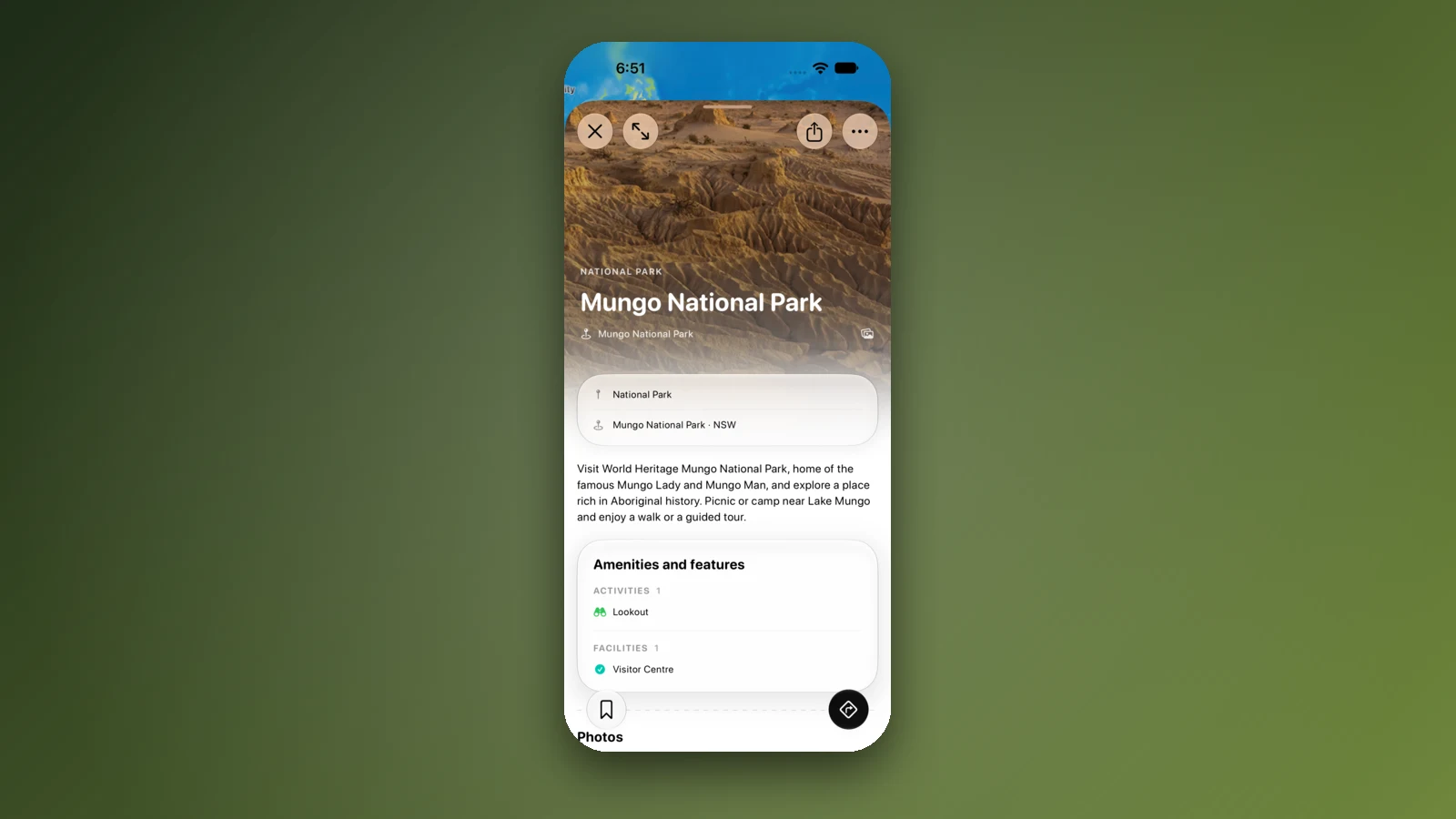
- iPhone only
- Rules from the land manager
- Confirm permits first
Places along the way
Check before you go
Rules and conditions change. Recheck the official source and the page for your exact park or campground before departure.
- Central Land Council: permits
- Northern Land Council: permits
- WA Government: apply for a permit to access or travel through Aboriginal land
- Ngaanyatjarra Council: permits
- Shire of Ngaanyatjarraku: travel through Aboriginal land permits
- Explore Parks WA: Mitchell River National Park
- APY: permit requirements and information
- NPWS South Australia: Mamungari Conservation Park
- Cape York Tourism Guide (Napranum Shire Council)
- Parks Australia: Kakadu park passes
- Parks Australia: Kakadu frequently asked questions
- Parks Australia: Uluru-Kata Tjuta frequently asked questions
Common questions
Do I need a permit to drive the Great Central Road?+
Yes. Western Australia says a transit permit is required between the Northern Territory border and Laverton, and the Ngaanyatjarra Council issues a 3-day transit permit for its section. The Northern Territory part from Yulara needs a Central Land Council transit permit for Tjukaruru Road. Apply before you travel, and allow two to three weeks for the WA applications.
Can I get a transit permit to cross the APY Lands in South Australia?+
No. The APY says transit permits are not issued to tourists, travellers or 4WD enthusiasts who want to pass through any part of the lands. Entry permits are for people with a purpose such as visiting family or friends or working there, and APY asks you to apply 30 days before your visit.
Do I need a permit for the Tanami Road?+
It is not on the Central Land Council's list of roads that need a transit permit. The CLC does say visitors to Aboriginal land outside larger communities need a permit, so do not assume the land beside the road is open for camping. Ask the CLC before you leave the road.
Is a permit free, and how long does it take?+
Often free, but the time varies. The CLC issues transit and simple permits free and entry permits take at least a week, the NLC says most permits have no charge and to allow up to 10 days (its recreation FAQ says at least 10 days may be needed), and Western Australian transit permits are free. Traditional Owners can set access or camping fees at some places, and permits can be refused.
Take it on the road
Save the stops. Plan the whole trip.
Build an ordered route from saved places, calculate the distance and keep dates, notes and to-dos attached.