Yes, but only with the owner's permission: camping on private land without consent is trespass. Whether the owner also needs council or planning approval to host you depends on the state and council, on how many people camp and for how long, and on whether anyone pays.
The short answer by state
Permission from the owner is the first rule everywhere. After that, approval rules for hosted camping are set by each state and, in many places, by each council. Hosts carry the approval duty, but a traveller who knows the basics can ask better questions.
| State or territory | What the rules say | Source |
|---|---|---|
| New South Wales | Council approval is not needed for up to two caravans, campervans or tents on any land with the owner's permission, if each stay is no more than two days at a time and total use is no more than 60 days in 12 months. Farms of 15 hectares or more can host up to 20 people for 21 days a visit without planning or building approval, if requirements including tents 6 metres from buildings and vans are met. | NSW Planning practice note, 1 July 2026; NSW Planning agritourism page |
| Western Australia | You can camp up to 5 nights in any 28 consecutive days on land you own or have a legal right to occupy. More than 5 nights needs written approval from the local government (up to 24 months) or the Minister. | Caravan Parks and Camping Grounds Regulations 1997 |
| Victoria | Set by council local laws and the planning scheme. Mount Alexander Shire, for example, requires a permit to camp on land without a dwelling, outside an approved camping ground, though it says a Local Law 13 change lets people camp in caravans or tiny homes on wheels without one (conditions not listed). A park must be registered as a caravan park with the council. | Mount Alexander Shire; Consumer Affairs Victoria |
| Queensland, South Australia, Tasmania, NT and ACT | We could not confirm a single state rule for hosted farm camping. Councils decide through their planning schemes, so ask the host whether the council has approved the site. | Local council |
- Owner permission first
- Approval is the host's job
- Checked 2026-10-21
Permission and trespass
Trespass is an offence, and each state has its own law. In NSW, the Inclosed Lands Protection Act 1901 makes it an offence to enter inclosed land without the consent of the owner, occupier or person in charge, or to stay after being asked to leave. Leaving a gate or slip-panel open is a separate offence under the same Act.
Queensland's Summary Offences Act makes it an offence to enter or remain in someone's house, yard or business premises without permission, with a maximum penalty of one year's imprisonment, and Legal Aid Queensland says police use discretion. Its page does not address paddocks or rural land, so ask a rural landholder before you rely on it. The practical rule is simple: no consent, no camp.
Get the owner's yes in a message or email, not only at the gate. It records the dates and number of people, and it helps if a neighbour or a ranger asks.
- Ask the owner or manager
- Keep the yes in writing
- Open gate is not consent
What the host has to get right
NSW treats a camping ground as a use needing development consent, plus a council approval under the Local Government Act unless an exemption applies. The 1 July 2026 practice note says a person who operates a camping ground without the required approval commits an offence, and councils can order the use to stop. Remote camping grounds can be approved as primitive camping grounds, which need a limited set of facilities including water, a toilet and refuse disposal, and allow an average of two sites per hectare.
Western Australia's rules turn on days. Up to 5 nights in 28 consecutive days needs the owner's approval only, according to the City of Kwinana, while longer stays need the owner and the local government. The City also says that if an owner regularly allows short-term camping, the property becomes a caravan park or camping ground and needs planning and building approvals. The WA Government says special approval is still required for more than one caravan on a single lot.
A host who charges campers can hit these limits quickly. That is their paperwork, but it explains why a farmer may say no, offer only two nights or point you to a registered site.
- Hosting rules differ by council
- Paying guests raise the bar
- Hosts may need approval
Fire bans and rural fire rules
Rural land carries the same fire rules as public land, with no ranger to remind you. In NSW, the Rural Fire Service says a Total Fire Ban means no fire in the open, and the exception for gas barbecues has conditions. Check the fire authority for the district on the morning you arrive, not just when you book.
Ask the owner where a fire is allowed, how close to dry grass or sheds, and where to find water. If a ban is on or a fire is not allowed on the property, plan a gas cooker meal or a cold one. The campfire guide covers the rules by state.
- Check the ban each morning
- Ask where a fire is allowed
- Keep water nearby
Farm conditions to ask about
A campsite on a farm may have no mains water and no sewer. NSW expects approved temporary camping grounds to have an adequate water supply, toilets and rubbish facilities for the time they run, so a host who is approved should be able to tell you what exists. If they are not set up, bring your own water, a portable toilet and a way to carry out all rubbish.
Ask about stock and dogs. Livestock can move through a paddock overnight, and a farm may not take pets. Ask which tracks you may drive on, where to park to keep vehicles off wet ground, and who to ring if you need help.
- Bring water and a toilet
- Ask about stock and dogs
- Take all rubbish out
Traveller tips for a farm stay
Ask first, and say how many people, what you are camping in and how long. Book through the farm or the platform it uses, and bring the confirmation. Arrive in daylight, because gates, creeks and cattle grids are harder to read after dark.
Leave gates as you found them: open if open, shut if shut. Stay on the tracks you were shown, keep noise down and take the whole camp out with you. Before you drive away, tell the owner you have left and thank them.
- Daylight arrival
- Gates as found
- Say goodbye
What to do instead
If the owner says no or the paperwork is unclear, there are plenty of legal options. Caravan parks and holiday parks have approvals and facilities. Park agency campgrounds and signed free camps are covered in the free camping legality guide, and the responsible camping guide covers leaving a place as you found it.
Private hosted sites are bookable through a few platforms, and the Hipcamp alternatives guide covers where to book. Whichever route you use, ask the host whether the site has any council approval it needs, and keep the booking confirmation with you.
- Caravan and holiday parks
- Park campgrounds
- Booked hosted sites
Find the alternatives in AussieCamps
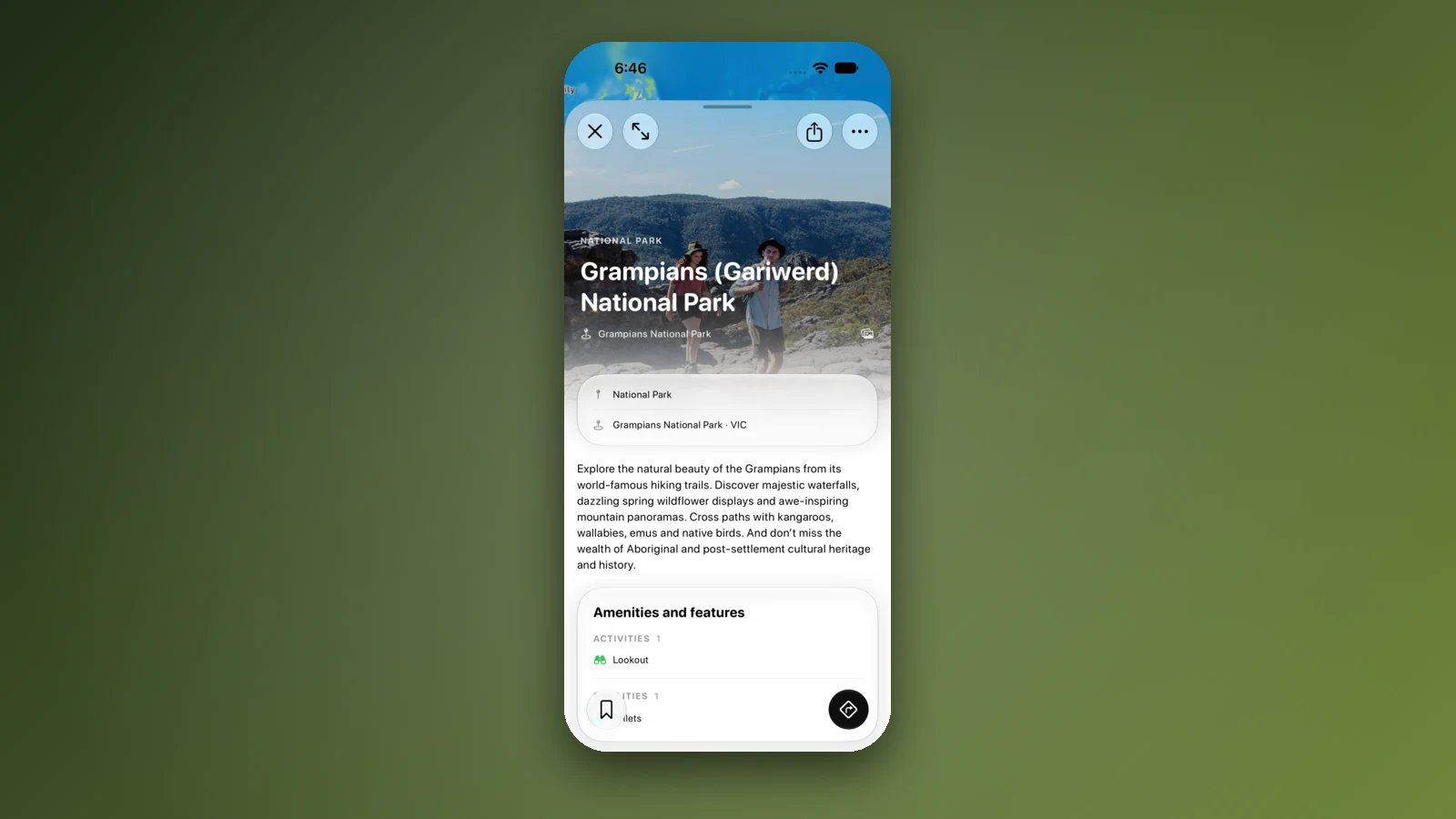
AussieCamps is built around public campgrounds, roadside rest areas and accommodation, with 1,838 campgrounds and 745 national parks, not private paddocks. Open a nearby place page to see what the land manager publishes on facilities, fees, rules and access, then weigh it against the farm night you are considering. Saved collections hold a backup list, and a trip strings the stops together.
Without reception, the stored place details still open, while routing, forecasts and photos do not load. It is an iPhone app. It cannot tell you whether a property has council approval or allows fires, so put that question to the owner.
- iPhone only
- Compare nearby park sites
- Ask the owner about approvals
Places along the way
Check before you go
Rules and conditions change. Recheck the official source and the page for your exact park or campground before departure.
- NSW Planning: practice note, caravan parks and camping grounds (1 July 2026)
- NSW Planning: five things you can do on your farm (agritourism)
- NSW legislation: Inclosed Lands Protection Act 1901
- NSW Rural Fire Service: Total Fire Ban rules
- WA legislation: Caravan Parks and Camping Grounds Regulations 1997
- WA Government: streamlined temporary accommodation approvals
- City of Kwinana: temporary accommodation
- Mount Alexander Shire: camping on public or private land
- Consumer Affairs Victoria: park registration
- Legal Aid Queensland: criminal trespass
Common questions
Is it legal to camp on a farm in Australia?+
Yes, if the owner or occupier says you can. Without that consent you are trespassing, and the owner can ask you to leave. Separately, the owner may need council approval to host campers, which is their responsibility, not yours.
Can I camp on my friend's land for a few nights?+
Often yes, with the owner's permission, but the limit differs by state. In NSW the council approval exemption covers up to two caravans, campervans or tents for no more than two days at a time and 60 days a year. In Western Australia you can camp up to 5 nights in any 28 consecutive days on land you own or have a legal right to occupy.
Can I camp in a paddock if the gate is open?+
Not on that basis. An open gate or a missing fence is not permission. Ask the owner or manager first, and leave any gate as you found it, because leaving one open can itself be an offence in NSW.
Does a farmer need approval to take paying campers?+
Often yes. In NSW a camping ground generally needs development consent and a council approval, and operating one without approval is an offence. A farm stay exemption covers up to 20 people at a time, for up to 21 days a visit, on farms of at least 15 hectares, with other requirements to meet, and other states set their own rules, so ask the host whether they are covered.
Take it on the road
Save the stops. Plan the whole trip.
Build an ordered route from saved places, calculate the distance and keep dates, notes and to-dos attached.