It depends, and in most parks the answer is no: Queensland says generators are not permitted in most parks and forests, and NSW generally does not permit them unless a sign or the park manager allows it. Where they are allowed it is campground by campground, within set hours, so read the sign or the park's own page before you bring one.
The short answer by state
There is no national rule. Each park agency decides, and most decide campground by campground. The table covers what each one says on its own pages, so treat it as a guide to the question you should ask the land manager.
| State or territory | What the land manager says | Source |
|---|---|---|
| New South Wales | Generally not permitted in parks. Allowed where a sign says so or the park manager consents. One generator per group, placed closer to your camp than to neighbours, and any noise curfew in the campground applies. | NSW National Parks and Wildlife Service |
| Victoria | No single park-wide rule found. Wilsons Promontory and Jimmy Creek campground (Grampians) list no generators. Warby-Ovens National Park allows them with fire-safety conditions. State forests allow them if used safely. | Parks Victoria, Victorian Government |
| Queensland | Not permitted in most parks and forests. Where allowed, low-noise generators up to 2.0 kVA and 65 dB at 7 m, with hours set on each park's page. | Queensland Government |
| South Australia | Check with the local parks office. Kati Thanda-Lake Eyre allows generators in daylight hours only, and Onkaparinga River says none except where permitted. | National Parks and Wildlife Service SA, Department for Environment and Water |
| Western Australia | Allowed at some campgrounds only, usually between 8am and 9pm but it varies. Banned at others. None on total fire ban days. | Explore Parks WA (DBCA) |
| Tasmania | Set per reserve. Lime Bay off by 9pm, Peggs Beach and Black River 10am to 8pm. Not permitted in Narawntapu National Park or over the bridge at Cockle Creek. | Parks and Wildlife Service Tasmania |
| Northern Territory | Not permitted unless authorised or signed as permitted. Keep River allows them at one campground, 7.30am to 8.30pm. Litchfield and Nitmiluk do not allow them. | NT Parks and Wildlife Commission |
| ACT | Motorised generator use is prohibited at Namadgi's Mount Clear campground. | Parks ACT |
| Commonwealth parks | Set per campground in Kakadu: Mardugal One lists generators permitted, Maguk lists none. | Parks Australia |
- Default is usually no
- Hours are set per campground
- Checked 2026-10-21
Where generators are allowed: the sign decides
NSW says generators are generally not permitted in parks, but some have signposted areas where they are. If there is no sign, you cannot use one without consent from the park manager. The NSW policy also counts a vehicle engine left running to charge batteries or power equipment as a generator.
Queensland's rule is the same in spirit: most parks and forests do not allow generators, and each park's page says whether yours does. In WA, the Northern Territory and Tasmania, the answer sits on the individual campground page, and a few larger WA campgrounds have separate generator and quiet areas.
A rule can also change on the day. NSW says use can be stopped for a period in a campground where it was previously allowed, for example for roosting birds or a local fire ban, and it must put up signs when it does.
- No sign usually means no
- A running engine can count
- Rules can change on the day
Hours and noise
Where generators are allowed, hours are short and set per site. Explore Parks WA says permitted hours are posted at the campground, usually 8am to 9pm. Peggs Beach and Black River in Tasmania allow them from 10am to 8pm, Lime Bay requires them off by 9pm along with all other noise, and Keep River's Goorrandalng campground runs 7.30am to 8.30pm. At Kati Thanda-Lake Eyre in South Australia, generators are for daylight hours only.
Queensland sets a noise limit as well as park-by-park hours: low-decibel generators up to 2.0 kVA, with a maximum of 65 dB at 7 m, unless the park says otherwise. NSW asks you to take reasonable measures to minimise noise and to obey any noise curfew in the campground.
- Hours are posted per site
- Queensland: 2.0 kVA, 65 dB at 7 m
- Daylight only at Lake Eyre
Fire bans and safe set-up
NSW, Queensland and Western Australia all say never to use a generator on a day of local fire ban or total fire ban. Parks Victoria's Warby-Ovens page is different: a generator may be used on a Total Fire Ban day only if a 3-metre area around it is cleared of anything flammable. That is one park, so do not assume it applies elsewhere.
The set-up rules are consistent. NSW and Queensland ask you to keep the generator clear of fuels and dry grass, run extension cords that are rated for outdoor use and do not cross access tracks, follow the manufacturer's guidelines and never leave it running unattended. Explore Parks WA asks for at least 3 m of clear space around it. Victoria's state forest page says to fit a spark arrestor to the exhaust, keep 1.5 m of cleared space around it, and have water or a stored-pressure extinguisher to hand. We did not find an official rule on fuel storage, so check the park's page.
- No generator on fire ban days
- Clear space around it
- Never leave it running
Rest areas and the roadside
At a Queensland general vehicle rest area, you must not operate a generator or engine-driven equipment between 7pm and 7am. A person who camps on a state-controlled road to manage fatigue must not operate a generator while camping, and the maximum penalty for breaching that rule is 20 penalty units.
We found no equivalent generator rule for rest areas in the other states, so the sign at the site is the guide. Queensland also says its rest areas are not camping sites.
- Qld rest areas: off 7pm to 7am
- No generator when roadside camping
Medical and disability exemptions
NSW, Queensland and Western Australia all make a path for people who need a generator for a medical device or disability aid. NSW asks you to contact the local NPWS office before you enter the park or book, with evidence such as a medical certificate. Queensland allows a small low-decibel generator of up to 2.0 kVA to charge auxiliary batteries for a medical device where generators are otherwise not allowed, with a current medical certificate. WA invites an application for exemption through its contact page.
- Contact the park before you go
- Bring a medical certificate
What to do instead
Queensland's own advice is to consider solar panels, inverters or charging while driving. A battery and inverter or a portable power station runs a fridge and charges devices without a generator's noise, and Victoria's forest page also encourages solar or battery power.
For power on tap, book a powered site at a holiday park or caravan park, which is where air conditioning and appliances belong. None of the WA park campgrounds have powered campsites, according to Explore Parks WA, so power there means bringing your own source or choosing a private park.
- Solar and battery first
- Powered sites at holiday parks
- Charge while driving
Check this rule at the place in AussieCamps
A place page in AussieCamps shows the land manager's facilities and rules as the park agency publishes them, and a power filter narrows 1,838 campgrounds and 745 national parks to sites that list power. The stored place details need no coverage; live maps, routing, weather and photos do. AussieCamps is made for iPhone.
It does not replace the official rule. Confirm with the land manager whether generators are allowed and when.
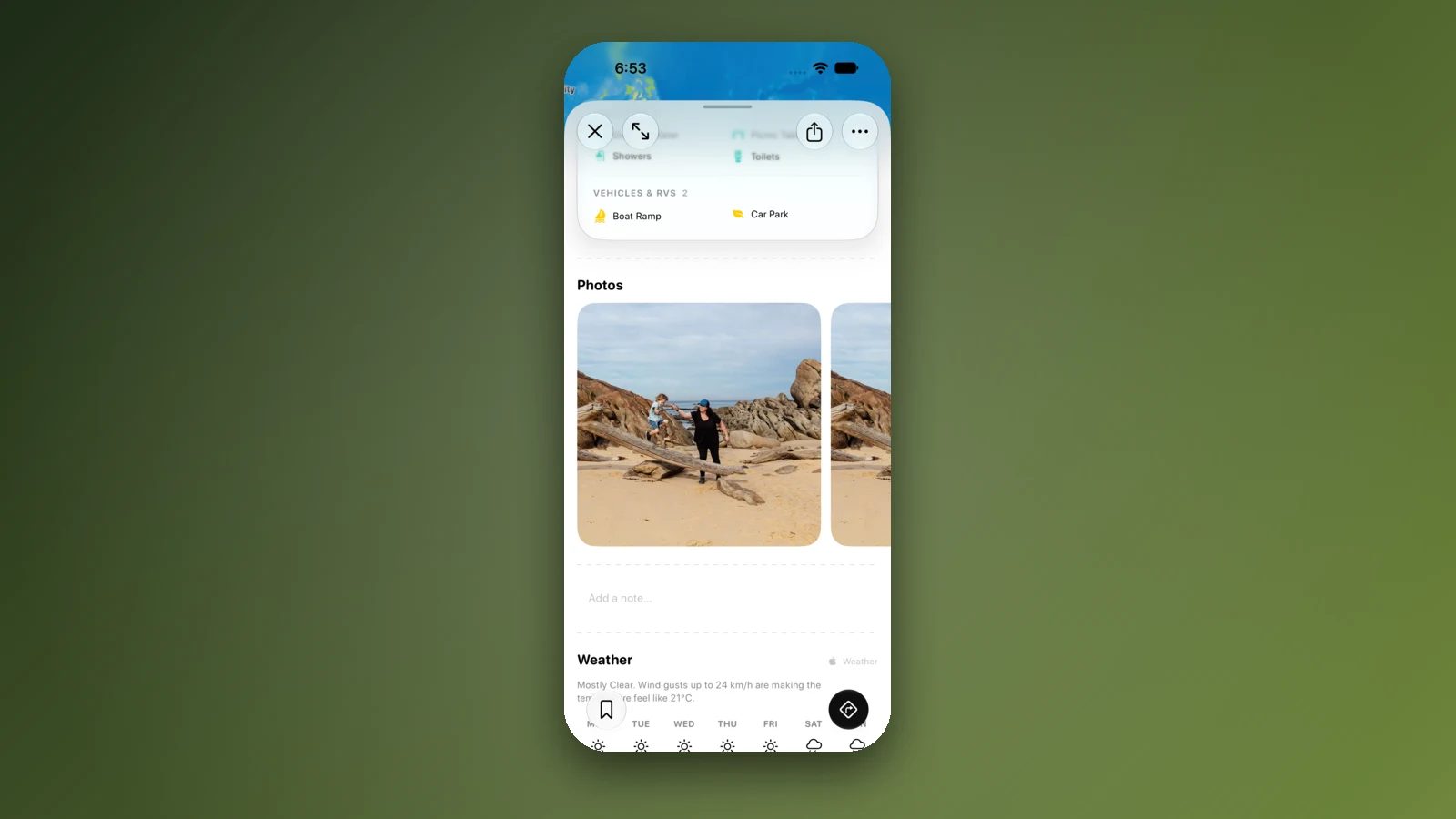
- iPhone only
- Rules from the land manager
- Confirm before you go
Places along the way
Check before you go
Rules and conditions change. Recheck the official source and the page for your exact park or campground before departure.
- NSW National Parks: generators when camping
- NSW NPWS: generator use policy
- Queensland Government: generator use in parks and forests
- Explore Parks WA: powered campsites and generators
- Victorian Government: camping in state forests
- Parks Victoria: Warby-Ovens National Park camping
- NPWS South Australia: camping essentials
- Parks and Wildlife Service Tasmania: Lime Bay camping
- Parks and Wildlife Service Tasmania: Peggs Beach and Black River camping
- Parks Australia: Maguk campground, Kakadu
- Queensland Legislation: Transport Infrastructure (State-controlled Roads) Regulation 2017
- NT Parks: Keep River National Park
Common questions
Can I use a generator in a national park in Australia?+
Only where the park allows it. Queensland says generators are not permitted in most parks and forests, NSW generally does not permit them without a sign or the park manager's consent, and Western Australia and Tasmania allow them at named campgrounds within set hours. Check the campground's own page or sign before you pack one.
What time do I have to turn my generator off at a campsite?+
It depends on the campground. Explore Parks WA says permitted hours are usually between 8am and 9pm, Lime Bay in Tasmania requires generators off by 9pm, and Keep River National Park in the Northern Territory allows them from 7.30am to 8.30pm at one campground. In NSW parks that have noise curfews, generators fall under them.
Can I run a generator at a roadside rest area?+
Not overnight in Queensland. The state's rules bar operating a generator or engine-driven equipment at a general vehicle rest area between 7pm and 7am, and a person camping on a state-controlled road must not operate one at all. Other states do not publish a rest-area generator rule we could confirm, so follow the sign.
Can I use a generator on a total fire ban day?+
Usually not. NSW, Queensland and Western Australia all say not to use a generator on a day of local fire ban or total fire ban. Victoria's Warby-Ovens National Park is the exception we found, where a generator may be used on a Total Fire Ban day only if a 3-metre area around it is cleared of anything flammable.
Take it on the road
Save the stops. Plan the whole trip.
Build an ordered route from saved places, calculate the distance and keep dates, notes and to-dos attached.